September 2, 2026
Hire a Drone Spreading Service vs Buy a DJI Agras T50
The break-even is a volume question, not a technology question. Here is the arithmetic behind custom-hire acres versus owning the machine — including the costs that usually get left out of the ownership column.
What It Is
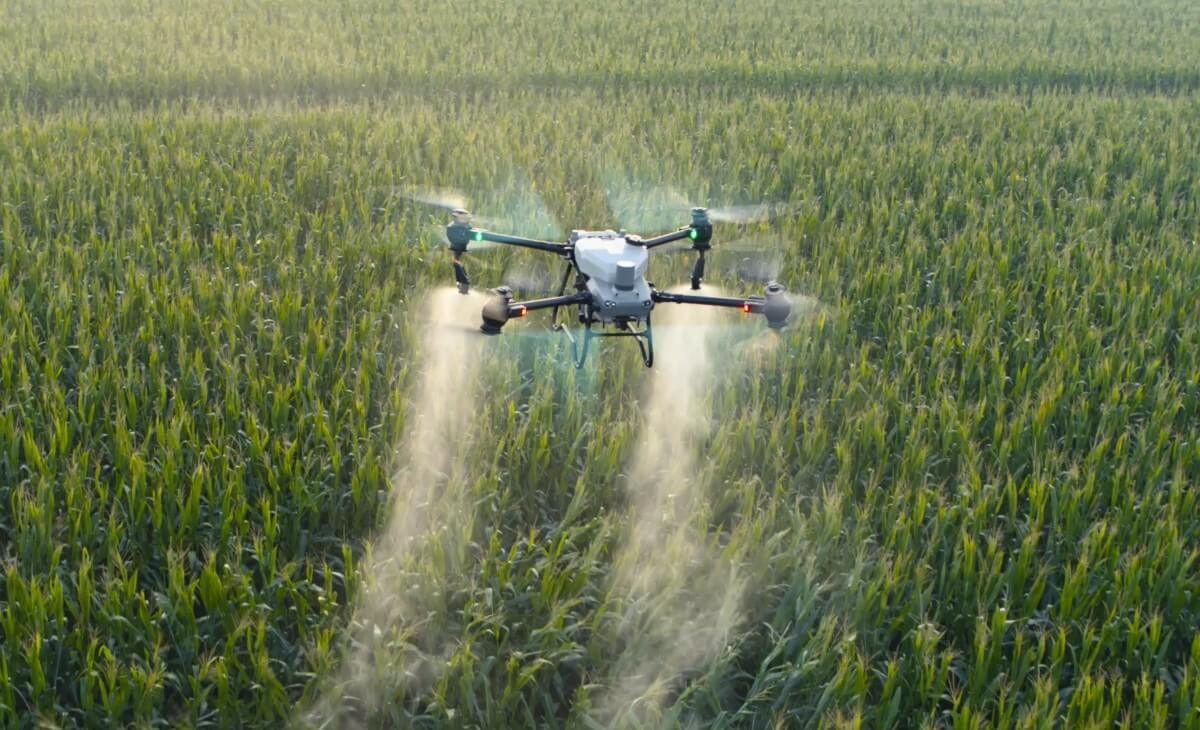
There are two ways to get granular product onto your fields by drone in Alberta. You can hire a custom operator — UAV AG brings the aircraft, the licences, and the crew, flies the pass, and bills you per acre. Or you can buy a machine like the DJI Agras T50, put your own pilot behind it, and fly your own acres.
Both end with the same product on the same ground. What differs is who carries the capital and who carries the risk of a machine sitting idle. That makes this a volume question rather than a technology question — and volume questions have an arithmetic answer.
Worth stating what the work actually is. The everyday, legal drone service in Canada today is granular spreading: dry fertilizer, cover-crop and forage seed. Drone pesticide application sits under a narrow interim pathway opened by PMRA’s June 2026 Letter of No Objection — limited to products already registered for conventional aerial application and flown to those label directions, with Transport Canada and provincial applicator licensing still applying. The economics below are for granular work.
Who It's For
Growers who have already decided drone application belongs on the farm and are now deciding how to buy it — by the acre, or by the machine.
It is also for anyone who has been handed a payback number by a dealer and wants to see the arithmetic behind it, including the costs that tend not to appear in the ownership column.
How It Works
The two columns, side by side.
| Factor | Hire UAV AG | Own a T50 |
|---|---|---|
| Up-front capital | None | Aircraft, batteries, charging, RTK base |
| Per-acre cost | The quoted rate — Alberta custom application typically $10 to $15 per acre | About $4.50 per acre operating, plus amortized capital |
| Effect of more acres | The rate stays the rate | Cost per acre falls with every acre flown |
| Certification | Ours — SFOC, licensed pilots, insurance | Yours to obtain, renew, and comply with |
| Labour | Ours | Your hours, in the middle of your season |
| Timing control | Booked into our schedule | Fly the moment your window opens |
| Idle risk | None — you pay for passes flown | An unflown machine still amortizes |
| OFCAF rebate | Not applicable | Up to $20,000 on an eligible unit |
| Best fit | Occasional passes, single-pass acres, trying it | Repeat acres, several passes a season |
The break-even, in one calculation. The UAV AG ROI calculator builds an ownership cost per acre from two pieces: the machine price after the OFCAF rebate, amortized over three years and spread across the acres you fly each year, plus about $4.50 per acre of drone operating cost. Custom hire has no capital piece at all — it is simply the quoted rate, and Alberta custom application typically sits in the $10 to $15 per acre band.
The two lines cross where amortized capital per acre equals the gap between them:
- Start with the machine price after the $20,000 OFCAF rebate.
- Divide by three, for the calculator’s three-year amortization.
- Divide again by the acres you expect to fly every year.
- Compare the result to $5.50 if you would otherwise pay $10 per acre, or to $10.50 if you would otherwise pay $15. Land under that number and owning wins on cost.
That is the whole mechanism. Everything else — financing at the calculator’s 8.5% APR, adding a second pass per season, running a heavier rate — moves the crossover by changing one of those three inputs. Rather than publish a payback figure that will be wrong for your acres, run the ROI calculator on your own numbers, and call 587-532-9000 for current T50 pricing to put into it.
Where the crossover tends to land. Annual acres flown is the lever that matters most, because it is the only one sitting in the denominator. A farm flying one light pass over a few hundred acres will not out-run a custom rate. A farm flying two or three passes across the whole operation will, and the margin widens every acre after that. The site’s own model carries the same shape — it points at the T50 for operations in roughly the 500 to 2,500 acre range, with the T25 below that and the T100 above.
What the ownership column leaves out. The $4.50 per acre is an operating figure, not a total. Sitting on top of it: your own time in season, RPAS certification and the SFOC that authorizes dispensing work, recurrent training, battery replacement as cycles accumulate, and the days a machine is down. None of those appear in a payback table and all of them are real.
So the honest version of the ownership case is narrower than the sales version. Owning wins on cost at volume, and it wins on control at any volume — you fly when your weather window opens rather than when a custom operator’s schedule allows. If timing is what actually hurts on your farm, that second point may decide it before the arithmetic does.
Key Dates
- The lever that decides it:Acres flown per year
- Custom rate reference:$10–15/ac typical Alberta custom application
- Drone operating cost:About $4.50/ac, before capital
- OFCAF rebate:Up to $20,000 per applicant
- Run your own numbers:UAV AG ROI calculator
- Current T50 pricing:Call 587-532-9000
How UAV AG Can Help
UAV AG sits on both sides of this decision, which is the reason to ask us rather than a dealer who only sells machines:
- →A custom spreading rate scoped to your actual application rate, field logistics, and acres — not a flat number that hides what drives it.
- →The same ROI model the site publishes, run on your acres, your passes, and current T50 pricing, so the payback figure is yours rather than a brochure average.
- →An OFCAF eligibility check and BMP Action Plan sequencing if you do buy — the rebate is lost to paperwork order more often than to eligibility.
- →Setup, RTK configuration, and hands-on training at your farm, plus parts and service after. An owned machine you cannot confidently fly is not a saving.
- →A straight answer when the acres are not there yet: we will quote the custom pass and tell you to revisit ownership when your volume moves.
A Note From Us
The number of Alberta farms that should own a spreading drone is smaller than the number of dealers selling them, and larger than zero. Both halves of that sentence matter.
If you fly a few hundred acres once a season, custom hire is almost certainly cheaper and it stays cheaper — you are renting capacity you would otherwise leave parked eleven months of the year. If drone application has become a repeat, multi-pass part of how you farm, the arithmetic flips, and it flips harder with every acre you add.
The honest way to find your own crossover is not to argue about it. Take the after-rebate price, divide by three years and then by your annual acres, add $4.50, and compare it against the custom rate you would actually be quoted. Then decide.
For what drives a custom per-acre number, see drone fertilizer spreading cost per acre and payload-to-acre. For choosing the machine if you do buy, see T100 vs T50 vs T25. For the certification an owner takes on, see SFOC.
Frequently asked questions
Is it cheaper to hire drone spreading or buy your own drone?
It depends almost entirely on how many acres you fly a year. Custom hire is a flat per-acre rate — Alberta custom application typically runs $10 to $15 per acre — with no capital behind it. Ownership costs about $4.50 per acre to operate plus the machine amortized across your acres, so its per-acre cost falls the more you fly. At low annual acres hiring wins; past the crossover, owning does.
How many acres do I need to justify buying a DJI Agras T50?
Work it out rather than take a number: divide the after-rebate price by three years, divide again by your expected annual acres, and see whether the result is under $5.50 (if you would otherwise pay $10 per acre) or under $10.50 (if $15). The UAV AG ROI calculator does this with current pricing. As a shape, the site’s own model points at the T50 for operations in roughly the 500 to 2,500 acre range.
Does the OFCAF rebate change the hire-versus-buy math?
Yes, substantially — it is the largest single reduction to the capital side. Up to $20,000 comes off an eligible drone purchase, which is the number that gets amortized over three years in the payback calculation. It is claimed once per applicant and requires a BMP Action Plan signed by an agrologist before the application, so it is worth sequencing carefully.
What does the ownership side of the calculation leave out?
The $4.50 per acre is an operating cost, not a total cost of ownership. It does not price your own time during the season, RPAS pilot certification, the SFOC required to dispense product, recurrent training, battery replacement as charge cycles accumulate, or downtime. Those are real costs that rarely appear in a dealer payback table.
Can I hire a custom operator now and buy a drone later?
That is the common path and usually the sensible one. Hiring the pass first tells you what the work is actually worth on your fields, how many acres and passes you really run, and whether timing or cost is your binding constraint — which are exactly the inputs the ownership calculation needs. Nothing about hiring first makes buying later more expensive.
Do I need a licence to spread granular product with my own drone?
Yes. Dispensing operations in Canada require Transport Canada authorization — an SFOC naming the aircraft and pilots — along with the appropriate RPAS pilot certification. That obligation transfers to you when you own the machine, whereas a custom operator carries it on your behalf. Granular fertilizer and seed spreading is the established legal drone service; pesticide application sits under a separate, narrow interim pathway.